

Search
When people are choosing air purifiers, they are often at a loss by the various promotional slogans provided by manufacturers. Among them, the most attractive ones are those like "Our purifiers don't need to replace the filter" or "The filter has a service life of up to 2 years". Many people have little understanding of the principle of air purification and blindly pursue an extremely long filter life, thus falling into a misunderstanding.
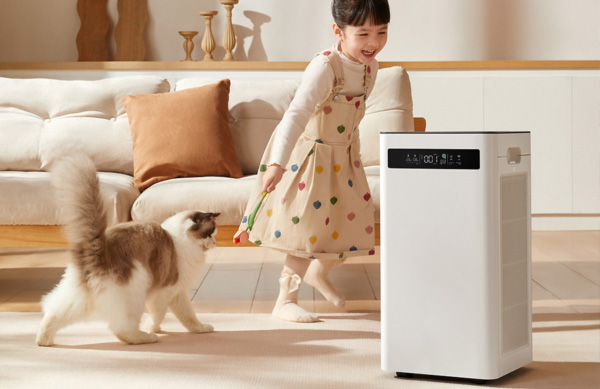
Air purifiers can be roughly classified into two major categories based on their working principles: electrostatic adsorption type and filtration type.
The filtering type, also known as the filter screen type, uses a high-volume and high-pressure fan to pass air through one or more layers of filter screens, filtering out particulate matter and volatile organic compounds within it. The current common approach for volatile organic compounds is to use activated carbon filters. The adsorption principle is to adsorb volatile organic compound molecules through the huge surface area of activated carbon. However, many people have misunderstandings about particulate matter filtration. It is not that the pore size of the filter screen is smaller than that of the particles and thus traps them. The main working principle is adsorption, which is also the reason why the filter screen must have a certain thickness.
For larger particles, due to their greater mass, their movement direction is not easily changed by the airflow and they are more likely to collide with the fibers in the filter screen during movement and be adsorbed. For smaller particles, due to their light weight, they are prone to change direction during movement under the influence of air flow or gravity. In such cases, there are two solutions: one is to increase the density of the filter screen to enhance the probability of collision interception; The second is to charge the particulate matter, thereby increasing the adsorption force.
This has given rise to another way of air purification: electrostatic adsorption. The technology of electrostatic adsorption is very easy to understand. Simply put, a strong electric field is applied in a space, and the particles are attracted and collide with the filter screen or what is called the dust collection plate, and are adsorbed. It is based on the same principle as electrostatic dust removal in industry. The air purifiers that manufacturers claim do not require filter replacement are products that use this technology. The main disadvantage of this technology is that its filtration efficiency is generally low, not reaching the 99.9% purification efficiency commonly achieved by filter-type purifiers. At the same time, another problem it brings is that due to the existence of a strong electric field, the generation of ozone is also relatively large. Ozone is also an air pollutant. Excessive ozone content can have an impact on the respiratory system. The specific amount of ozone released needs to be tested by a third-party institution.
As for the filter-type purification method commonly adopted by current air purifiers, since the filters commonly use HEPA filters for filtration, the HEPA filters will gradually become saturated as the number of adsorbed particles increases, and the dust holding rate will gradually decrease, thereby leading to a reduction in the efficiency of the purifier and an increase in energy consumption. Meanwhile, the particulate matter adsorbed on the filter screen is also a breeding ground for viruses and bacteria, where they can multiply and breed. If it is not replaced for a long time and continues to be used, it will not only fail to achieve the purification effect but also cause secondary pollution and become a source of pollution. In fact, considering the domestic air quality, it is recommended that the filter be replaced after three months of use to ensure your health. The picture below shows the filter of an air purifier after long-term use. I wonder what everyone's feelings are after seeing it?